Rendering
Richer Editor registers three macros on Filament's RichContentRenderer, available anywhere you render stored content.
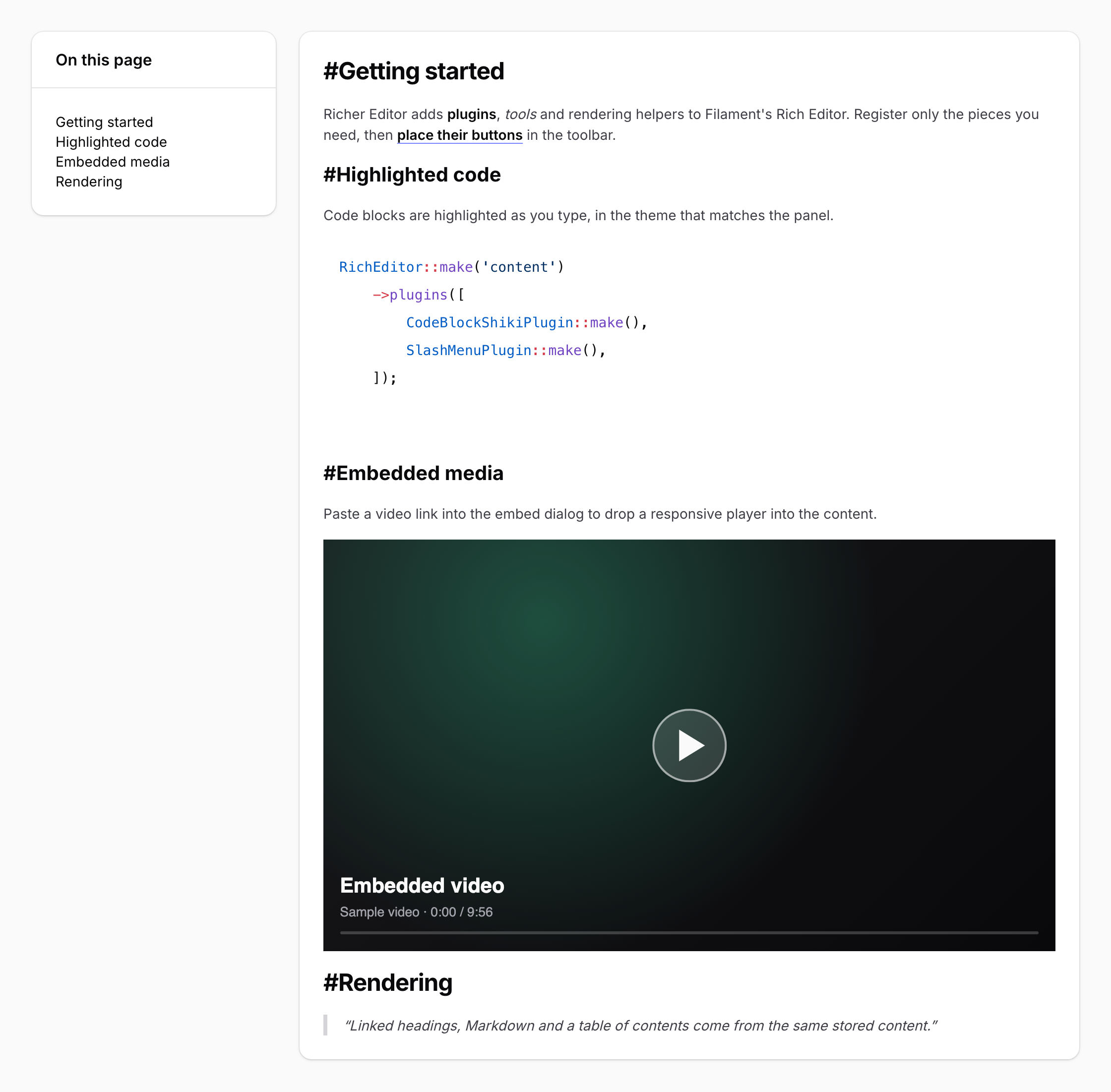
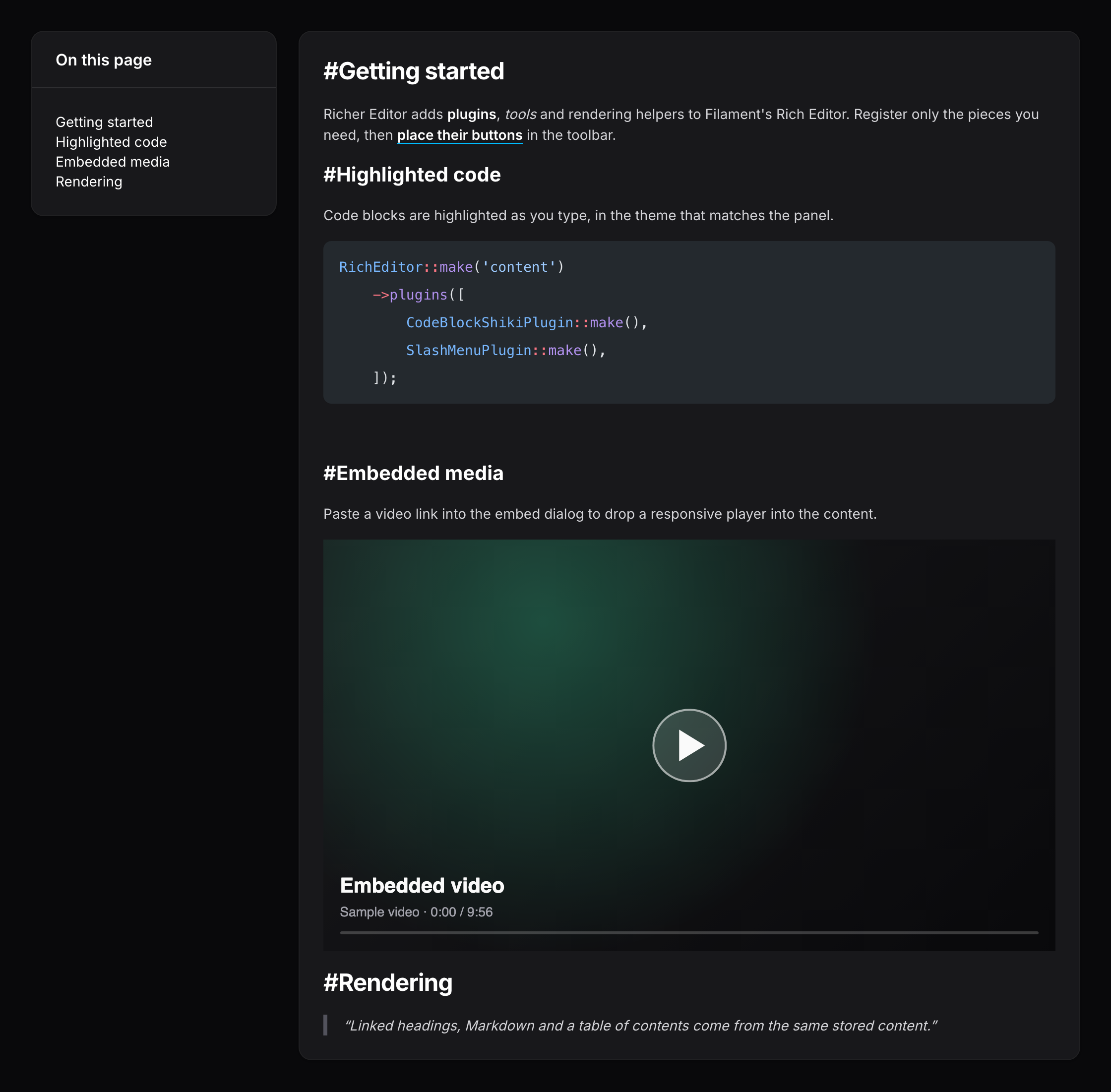
Linked headings
Turn headings into anchor links:
use Filament\Forms\Components\RichEditor\RichContentRenderer;

RichContentRenderer::make($content)
    ->linkHeadings(level: 3, wrap: false)
    ->toHtml();
level sets how deep to go, defaulting to 3. wrap controls whether the heading's text is wrapped in the link or the link is placed alongside it; it defaults to false.
For headings to carry stable ids, register IdPlugin on the field they were authored in.
Markdown
Convert stored content to Markdown:
use Filament\Forms\Components\RichEditor\RichContentRenderer;

RichContentRenderer::make($content)
    ->toMarkdown(options: []);
Conversion uses HTML To Markdown for PHP; anything in options is passed straight to its converter, so see that project's documentation for what it accepts.
Note this returns a Markdown string rather than a renderer, so it ends the chain — there is no toHtml() after it.
Table of contents
TableOfContents reads the headings out of stored content and builds a nested table of contents.
use Awcodes\RicherEditor\Support\TableOfContents;

TableOfContents::make($content)
    ->asHtml();
Or take the structure and render it yourself:
use Awcodes\RicherEditor\Support\TableOfContents;

$toc = TableOfContents::make($content)
    ->asArray();
Both accept a maxDepth argument controlling how many heading levels are included, defaulting to 3:
TableOfContents::make($content)->asHtml(maxDepth: 2);
Embeds
toHtml() sanitizes its output, and Filament's sanitizer removes <iframe> elements. Without extra configuration, EmbedPlugin content renders as an empty <div class="embed">.
EmbedPlugin::allowEmbedsIn() allows the iframe the embed renders. It keeps an iframe's src only when the URL is https and on one of the embed hosts: www.youtube.com, www.youtube-nocookie.com and player.vimeo.com. Apply it to Filament's sanitizer configuration in a service provider's register() method:
use Awcodes\RicherEditor\Plugins\EmbedPlugin;
use Symfony\Component\HtmlSanitizer\HtmlSanitizerConfig;

public function register(): void
{
    $this->app->extend(
        HtmlSanitizerConfig::class,
        fn (HtmlSanitizerConfig $config): HtmlSanitizerConfig => EmbedPlugin::allowEmbedsIn($config),
    );
}
Pass your own list of hosts as the second argument if you embed players from elsewhere:
EmbedPlugin::allowEmbedsIn($config, [...EmbedPlugin::EMBED_HOSTS, 'media.example.com']);
The sanitizer configuration is shared by everything that sanitizes HTML through Filament, so this allows these iframes wherever Filament sanitizes, not only in rich content.
Code blocks
Rendering highlighted code is covered separately — see Code blocks.